Check out this great video from Lutheran World Relief! I thought myself while watching the original, where are the women? LWR got it right on. Women feed most of the world's population...
Friday, February 8, 2013


Saturday, January 12, 2013
Seeing Through the Camels
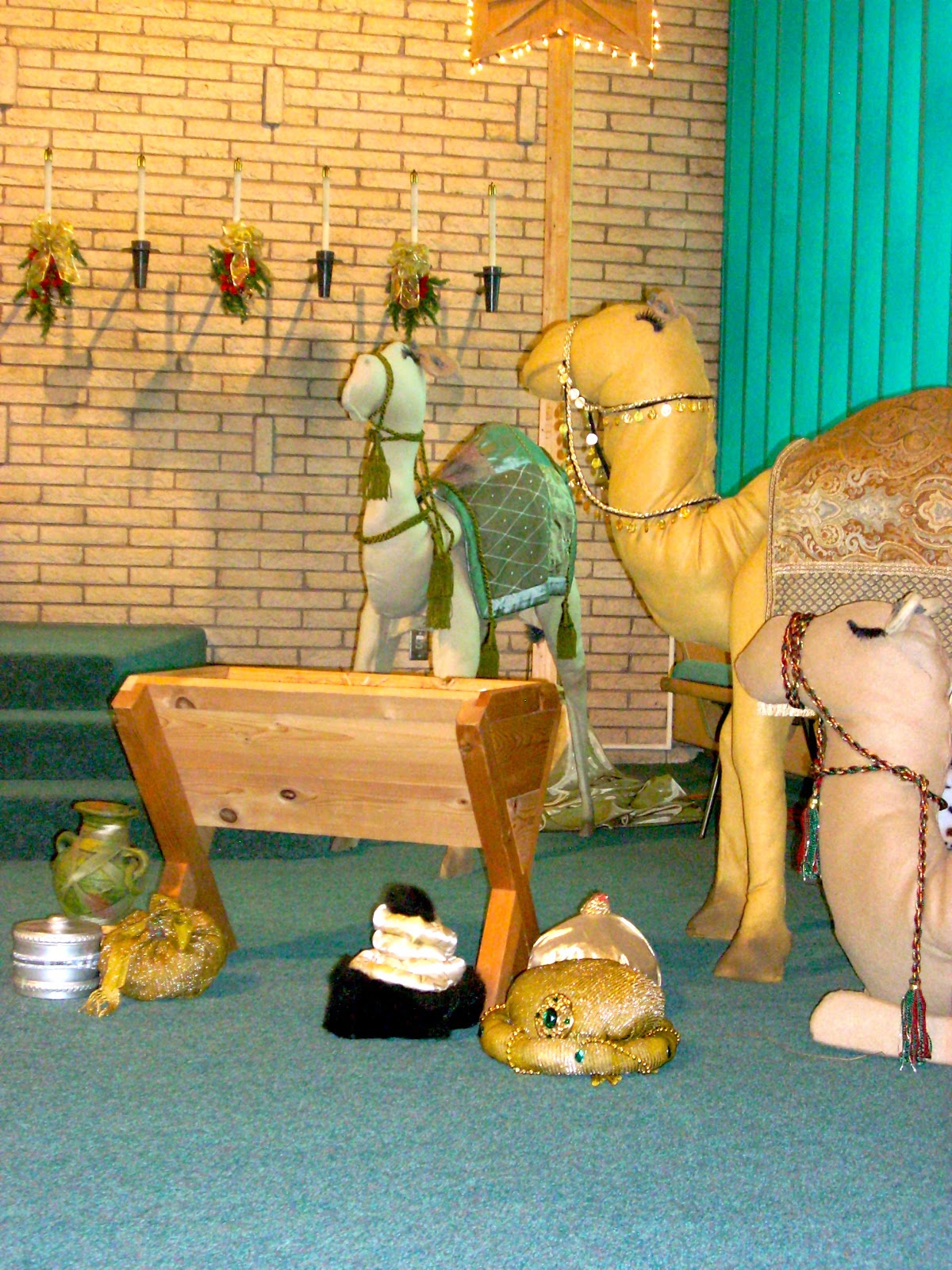
I had a really unique view on Sunday morning at the service in town.
Knowing that we were going to be celebrating Epiphany day and reading about the magi, I had asked if we could please use the camels from the Christmas program. They are the best hand-made camels I have seen and have a great deal of personality. I thought it would be good atmosphere and add some fun and imagination to the celebration. What I didn't count on was the placement of the camels.
I was running a little later than normal so I didn't have time to check the sanctuary before worship and was glad to see the manger and the gifts and those wonderful camels under the star. I didn't think about it until it came time for me to sit in my chair when I realized it was back behind the camels.
During different parts of the service, when it came time for me to sit, I had to look out from behind and around the camels to see the manger and to see the congregation. It was a totally different perspective.
Usually as I preside over worship, I see everyone and everything; but Sunday was different. Unless I moved away from the manger and stood in front, I could only get a partial glimpse of the manger and what was happening in front of me. As I looked, I realized that I have only looked at manger scenes from the front, like watching a performance but Sunday, I saw a view I've never seen before.
I have had that same kind of feeling sometimes when I am studying scripture and I come across a very familiar story that I think I know so well. I think I know the story and the characters and often even the meaning but as I study them, I come across details and ideas that I have not seen before. The story of the Magi is a good example of a story we think we know so well until we really read it. Then we find out that Matthew never tells us how many magi there were or whether or not there were camels. In fact, many of the details we think we know aren't in the Bible!
Both of the experiences are reminders that we need to allow ourselves to be open see and hear the Gospel from a new point of view not only on the page, but also in the people around us. When we think we already know what is coming and what it means, we rob ourselves of new insights, new gifts, and renewed relationships.
In the ninth chapter of John, Jesus heals a man who had been born blind. There are a lot of people that do not understand and question what Jesus has done. At one point, they do not believe that he is the same man until they confront his parents. They are not able to see or believe the truth of Jesus. Finally, they drive out the man whom Jesus healed.
He comes to Jesus and Jesus talks to him and reveals his identity. The man confesses his faith and worships Jesus. He is able to see and believe in Jesus but the Pharisees are not. Jesus warns them (and us) of the peril of refusing to see the truth of Jesus.
Jesus opens our eyes to see with the eyes of faith. Try seeing things in new ways, opening your heart and eyes to the new possibilities of God's love and grace.
"Jesus heard that they had driven him out, and when he had found him, he said, 'Do you believe in the Son of Man?' He answered, 'And who is he, sir? Tell me, so that I may believe in him.' Jesus said to him, 'You have sen him, and the one speaking with you is he.' He said, 'Lord, I believe.' And he worshiped him. Jesus said, I came into this world for judgment so that whose who do not see may see, and those who do see may become blind.'" John 9:35-40
In the ninth chapter of John, Jesus heals a man who had been born blind. There are a lot of people that do not understand and question what Jesus has done. At one point, they do not believe that he is the same man until they confront his parents. They are not able to see or believe the truth of Jesus. Finally, they drive out the man whom Jesus healed.
He comes to Jesus and Jesus talks to him and reveals his identity. The man confesses his faith and worships Jesus. He is able to see and believe in Jesus but the Pharisees are not. Jesus warns them (and us) of the peril of refusing to see the truth of Jesus.
Jesus opens our eyes to see with the eyes of faith. Try seeing things in new ways, opening your heart and eyes to the new possibilities of God's love and grace.
"Jesus heard that they had driven him out, and when he had found him, he said, 'Do you believe in the Son of Man?' He answered, 'And who is he, sir? Tell me, so that I may believe in him.' Jesus said to him, 'You have sen him, and the one speaking with you is he.' He said, 'Lord, I believe.' And he worshiped him. Jesus said, I came into this world for judgment so that whose who do not see may see, and those who do see may become blind.'" John 9:35-40
Friday, January 4, 2013
Freed Love

We've survived the rollover of the Mayan calendar. Congress finally got us over the "fiscal cliff". And the new year has begun. And soon the twelve days of Christmas will be over.
Many of us will try to start the new year out with resolutions to make a "fresh start" trying to kick old habits, and vowing to live healthier lives. Media has picked up on this and enlarged this very common need to want to make ourselves and our lives better. I notice that more and more, it gets harder to separate the commercials from "media stories" (I don't really want to call it news) about what to buy or use to get thinner, stronger, buffer, more organized, etc... And it's all focused on doing it right now as we begin a new year - as if this is the only or the best time to make changes in our selves and our lives.
Until it's time to get ready for "swimsuit season".
But that is exactly the problem with all of these resolutions. First of all, they assume that it is in our power to change ourselves and that if we don't then it is our fault. And because it is centered around the new year, we have both the excuse and the catch of waiting until next year to try again. Cartoonists are great at skewering us in our foibles. One I saw recently had the character saying that he was just going to use last year's list of resolutions for this year. He didn't need to change it because he still needed to do them all!
Sometimes, we are able to keep new year's resolutions and make some real changes but more often than not, what most people seem get from the experience is a sense of failure. One more time, one more thing not completed or not fixed.
Wouldn't it be nice if there was an alternative?
And there is. It's called grace. God makes things different.
First of all, God's love comes first, just as we are with all our faults, our bad habits, our past, and our inability to fix ourselves.
There is forgiveness. When we fail,fall, or mess up once again, God comes with forgiveness. There is no such thing as only one chance or second chances. Jesus talks about 70 times 70 (or more depending on how you translate the Greek).
Change does not happen on our own. As it says in the Small Catechism, "I believe that by my own understanding or strength..." but it is the Holy Spirit who calls, gathers, enlightens, and makes holy the whole Church. Jesus promises to always be with us.
We get a new chance every day. We do not have to wait for the new year to begin again to have a new chance. Even though you are only baptized once, we are invited to remember that baptism everyday and know that every day even many times in the day, we can come to God and be washed again from our sin, our doubts, our failures, our pain, and whatever we need to bring to God. Day by day or minute by minute, God is with us, giving us new life and freeing us.
We are set free from the measuring rulers and chains of "shoulds" to love others and to love ourselves, which we can only do with God's help and yet are the very things that mark us as people of faith. For just as we cannot come to faith or change without God, the Holy Spirit calls us into community for our survival. It is together that we have new life.
"For you were called to freedom, brothers and sisters, only do not use your freedom as an opportunity for self-indulgence, but through love become slaves to one another. For the whole law is summed up in a single commandment, "You shall love your neighbor as yourself." Galatians 5:13-14
Tuesday, December 18, 2012
The No-word Prayer

Away in a manger, no crib for his bed,
The little Lord Jesus laid down his sweet head;
The stars in the sky looked down where he lay,
The little Lord Jesus asleep in the hay.
The cattle are lowing; the poor baby wakes,
But little Lord Jesus no crying he makes.
I love you Lord Jesus, look down from the sky
And stay by my cradle till morning is nigh.
In the second verse, as the singers, we ask Jesus to stay with us through the dark and scary night. The carol is not only a song about the nativity, the birth of Jesus in the stable; the carol is also a prayer that Jesus would stay with us, chase fear away and keep us safe.
The third verse is even more of a prayer:
"Be near me, Lord Jesus; I ask you to stay
Close by me forever and love me, I pray.
Bless all the dear children in your tender care
And fit us for heaven to live with you there."
These last days have shattered the bubble of safety we try to keep around children. We wish and pray that our children would never have to know real terror and fear, forgetting that even everyday things and situations can make them afraid from monsters under the bed, having the right answer in school, to facing a bully. Talking to our children about times when we become afraid and giving them tools to use is part of helping them to be resilient.
Prayer is one of the most powerful tools we have against dark and fearful times.
There are many ways and kinds of prayer. Like the carol, we can sing our prayer; many hymns are sung prayers. Written out prayers that we read or memorize are another way to pray. May children learn the bedtime prayer, "Now I lay me down to sleep, I pray the Lord my soul to keep. If I should die before I wake, I pray the Lord my soul to take." It also is a prayer of asking Jesus to stay with us and keep us safe. Sometimes, these kinds of prayers have many words.
We can also just pray by telling God what we are feeling or what we need in whatever words we have at the moment. They can be informal or formal, lots of words or just a few. There are also times when all we have is one word - help. God hears even one-word prayers and is with us.
But sometimes, great fear and/or grief are so overwhelming that we can't find any words to say. The Bible tells us that at those times, perhaps the most powerful, God hears our no-word prayers. Paul writes, "Likewise the Spirit helps us in our weakness... that very Spirit intercedes with sighs too deep for words. " (Romans 8:26) When our hearts are too full or when they feel completely empty, those are the times that God hears us and holds us most deeply; even when all we have are questions or anger.
Since these deepest "no-word" prayers come through the Holy Spirit, like all prayers, they do not depend on our experience of prayer. They can be our first prayer or our last. God hears and holds us in love. And the promise is that there is nothing terrible or strong enough to take us away from that love.
In these last few days before Christmas, it is an even more important time right now to remember that the Jesus we wait for is the light of the world; the light that came into the world and that darkness has not and cannot overcome it. God's love wins.
"For I am convinced that neither death, nor life, nor angels, nor rulers, nor things present, nor things to come, nor powers, nor height, nor depth, nor anything else in all creation, will be able to separate us from the love of God in Christ Jesus our Lord." Romans 8:38-39
(Taken from last Sunday's children's sermon)
Wednesday, December 5, 2012
Who Needs Church?

I began by responding that no, Jesus never told us to go to church. There isn't a law about going to church. The gift of faith isn't invalidated or cancelled if you don't attend.
However, he and his disciples go to the synagogue throughout this ministry and Jesus is pictured more than once as teaching in the temple. From the beginning, following the resurrection, the disciples gathered together for prayer and hear the Word, to share the Meal, and to care for those in need. Following Jesus is not pictured as a solitary activity but instead, Jesus calls and gathers people together. The vision that Paul gives of those who follow Jesus is that together, we are the body of Christ. All of us together make one body.
But my students pushed. 'So I don't HAVE to go to church if I can still believe.'
So I challenged them back. "Right. You may not need to, for yourself. But there are people who need to see you there." Worship is not just about getting but also about giving. One of the major challenges of small town and rural ministry is our shrinking and aging communities. Most of our members are very aware of how things have changed over the last 60 years and how they continue to change. Having our younger members at worship and actively participating and visible in leadership and servant roles is a clear sign of hope and life that the congregation needs. It's not about "passing confirmation" or being good, it is one action that can really make a difference in the lives and outlook of other members.
I'm afraid I got passionate and sermonized a bit. But to get back to the original question, does it really matter?
Yes, it matters. We are created to be in partnership, to be in companionship with one another and with God. The second chapter of Genesis tells of God's search for partnership, for companionship 'because it is not good for one to be alone'. From the resurrection on, God's people have been gathered together around word and sacrament.
Can you pray and hear the word while watching your television or with an on-line community? Sure. But your screen cannot feed you at the Lord's table. We are not just about spirituality and good living, we are the people of God's bread, fed at God's table, and sent to bring that bread out into the world. Real bread. Bread that brings forgiveness but also the bread brought as gifts that goes out to feed the hungry, care for the sick, and gathers in the lost.
Belonging to God is not just an exercise of the inner spirit. Faith is attached to the real physical things of life and death. Both inside and out side of the church, we neglect this truth at our own peril. The Word leads to prayer leads to bringing our gifts leads to thanksgiving leads to the table and back out again into the world to serve and to share. Neither worship nor table nor prayers are an end to themselves but a cycle that strengthens both faith and life.
Can you pray and hear the word while watching your television or with an on-line community? Sure. But your screen cannot feed you at the Lord's table. We are not just about spirituality and good living, we are the people of God's bread, fed at God's table, and sent to bring that bread out into the world. Real bread. Bread that brings forgiveness but also the bread brought as gifts that goes out to feed the hungry, care for the sick, and gathers in the lost.
Belonging to God is not just an exercise of the inner spirit. Faith is attached to the real physical things of life and death. Both inside and out side of the church, we neglect this truth at our own peril. The Word leads to prayer leads to bringing our gifts leads to thanksgiving leads to the table and back out again into the world to serve and to share. Neither worship nor table nor prayers are an end to themselves but a cycle that strengthens both faith and life.
We gather and share ancient words of faith in the creeds. There are times when because of grief or doubt or confusion, I may not understand or be able to claim it as "my" statement of faith, but I can find comfort in the weight of the millennia of saints before, with, and after me that affirm what I cannot firmly hold for myself. It is like a bank that holds the riches in trust for us that we can draw upon when our own pockets of faith feel empty. The words spoken with sureness by all the gathered around us bear witness to God's power and promise even we come before God weak, or empty, and even in anger.
The saints around us are not perfect. They may come grumpy or empty themselves. It is not in the perfection of the assembled people or our worship that matters; we just need to trust in the promise that together Christ is among us and even more than that; together we are the body of Christ given to the world, warts, grumps, hugs, confusion and all.
As you prepare for Christmas, take time to breathe and be gathered together in Christ.
"For where two or three are gathered in my name, I am there among them." (Matthew 18:20)
"But as it is, God arranged the members in the body...If all were a single member, where would the body be? As it is there are many members, yet one body. The eye cannot say to the hand, "I have no need of you," nor again the head to the feet, "I have no need of you." Now you are the body of Christ and individually members of it." (1 Corinthians 12:18-21,27)
The saints around us are not perfect. They may come grumpy or empty themselves. It is not in the perfection of the assembled people or our worship that matters; we just need to trust in the promise that together Christ is among us and even more than that; together we are the body of Christ given to the world, warts, grumps, hugs, confusion and all.
As you prepare for Christmas, take time to breathe and be gathered together in Christ.
"For where two or three are gathered in my name, I am there among them." (Matthew 18:20)
"But as it is, God arranged the members in the body...If all were a single member, where would the body be? As it is there are many members, yet one body. The eye cannot say to the hand, "I have no need of you," nor again the head to the feet, "I have no need of you." Now you are the body of Christ and individually members of it." (1 Corinthians 12:18-21,27)
Thursday, November 8, 2012
Dancing Down the Aisle!

It was probably a bit different than many weddings you go to. For one thing, there were a lot of pastor-types around. Not only are my husband and I both pastors, but Ben is a pastor, his wife Mara is finishing her studies at Seminary this year, and they involved many of their friends in the service. I lost count at 9 (I think) and that was just at the rehearsal!
You might think that with all those clergy around, it was a somber, serious affair with a large dose of "you have to do it this way". Granted, there was a bit of discussion about where people were going to stand, sit, and process but it was more about how to make things work well rather than laying down any sort of liturgical order. It was one of the most relaxed and joyful weddings I've experienced. You could tell that people felt at home in the church, even though many of us were there for the first time.
Some of the differences from TV/movie weddings:
Perhaps the most central difference was that Ben and Mara put the focus of the service on God and living in faith. For them, this was most definitely a worship service of Word and Sacrament and they came for God's blessing. All of the other choices followed from this truth.
* The entire wedding party entered the church in procession while the congregation sang "Christ Has Arisen, Alleluia" (a Tanzanian Easter hymn) and we fairly danced out to "Let Us Talents and Tongues Employ". We sang "Where Charity and Love Prevail" as hymn of the day. This is something my husband and I did at our wedding. I wish I could say I was smart enough that we knew it when we did it, but doing that has been a great blessing. Unlike wedding songs that are soon forgotten or become embarrassing later on, our hymns have followed us throughout our lives, continuing to connect our marriage to faith in God.
* We celebrated Holy Communion and along with that (as was true from the beginning in the early church), an offering was taken going to a more local charity and the ELCA Malaria Campaign.
* Along with the Flower Girl, they had a Bible-bearer. Instead of a ring bearer with little pillow, Ben's Godson carried a Bible to the front which then was read and preached from during the service and is now Ben & Mara's family Bible.
* The preacher was carefully chosen and lifted up the Good News for all of us. We were both challenged and filled.
When the service was done, my younger sister remarked, "Why can't church on Sunday be this much fun?"
The reality is that it can be. This service was carefully and thoughtfully planned with a lot of effort and focus. The presiding pastor did not carry that burden alone. There were a lot of people that came prepared to worship with holy glee and celebrate faithfully. I'm afraid that all too often, pastors (myself included) come to worship bearing the burden of the service alone or nearly alone, and doing what has been done because they are too busy, tired, rushed, crammed, or depressed to do anything else.
What if a group came to church earlier in the week to plan and rehearse for worship? What if many of the people came to worship ready to give to those in need, to come hungry to the table, to pray, and to celebrate the gift of Christ? What if we allowed ourselves to come to worship expecting to have fun?
Worship can be fun when we come faithful, when we come prepared, and when there is participation by many in the preparation, and no one person is counted on to do everything. No one has shoulders big enough to carry that for very long. Liturgy really is the work of the people and the more of us that come ready to participate and give of ourselves faithfully, the fuller our experience will be. The more we give, even sitting in the pew, the fuller our hearts will be. Worship is not about what we get but what we give. Read: Acts 2:46-47.
Wednesday, November 7, 2012
Subscribe to:
Posts (Atom)