Tuesday, June 4, 2013
Show It Off!
I love the Confession and Forgiveness for this summer season found in Sundays and Seasons. After our confession that we have come together for healing and life, and for the sins that diminish us, then come the words of absolution, the declaration of forgiveness is given. And that ends with these words: "Be at peace, and tell everyone how much God has done for you."
I don't remember that being included before, but I really love the way it ties the assurance of God's love and forgiveness with our response to tell everyone how much God has done for us. After everything we have just been promised and given to us, it seems like a natural thing to tell people how wonderful it is!
It seems so easy to tell people when other good things happen to us, whet her it is our latest diet, a good place to eat lunch, or passing on the latest video gone viral. We "like" things on Facebook, "retweet" sayings from Twitter, and pass on links to the cutest kitten video.
And here, God meets us face-to-face, knowing all that we've admitted to and even the things we cannot name, and gives you and gives me complete love and forgiveness. God holds nothing back in welcoming and loving us just as we are, and gives us healing and life in spite of all of our questions, uncertainties, and weaknesses.
God does more for us than we can expect or ask from anyone. And what is our response? Tell someone else (even just one person) what God has done for us? Are you nuts?
We all have our reasons for not sharing from we are too shy, we don't know how to explain things, to 'faith is too personal, let's leave it at that'. And yet as someone who has done a lot of flying around the country when I worked for disaster response, I can vouch for the fact that there is not much we think is too personal these days.
I have sat at in an airport and heard what people share when talking (loudly and in close proximity) on their cell phones. I have heard about everything from the details of someone's sex life to their deepest joys and griefs. And that's not getting into all the details shared on the net, complete with pictures.
But to share what God has done for me? That would be admitting that God is in my life and my life is in God. Do we really have to get particular about it?
After all, what has God done?
The amazing gift of knowing that God knows me better than I know myself, all the deepest and darkest secrets and still loves me is the foundation that makes life possible in the face of what has happened in my life. The gift that knowing that when I am most afraid for those I love and that even when they face death, there is someone I can turn to who has the power to bring hope even then. The strength of knowing that I am never alone, even when I am most afraid or most ashamed. And the depths of love that has been given to me that has taught me how to reach out to others instead of running away in distrust or hate.
God gives me the joy that I see in each new life; the peace of the wind and sun in the trees and the song of the birds; and the gratitude I have for being saved from the darkness that nearly overwhelmed me and my life. It can be as deep as that, or the simple pleasure of melting chocolate on a marshmallow.
In the telling of what God has done for us, even just the smallest gesture, in admitting that we are people of faith, we set our lights to shine in the world. The very words used in the baptismal service: "Let your light so shine before others..." When we do this, we point the way to God, and the Gospel is heard. We don't have to be great at it, just open and honest about God.
A friend shared these words with me the other day in spending time in the Word: "A foghorn lets you know there is something out there, but the lighthouse tells you where it is". There are a lot of foghorns in the world, telling us to be afraid, but faith is the lighthouse that brings us safely home.
"You are the light of the world. A city built on a hill cannot be hid. No one after lighting a lamp puts it under the bushel basket, but on the lamp stand, and it gives light to all in the house. In the same way, let your light shine before others, so that they may see your good works and give glory to your Father in heaven." Matthew 5:14-16
Tuesday, May 7, 2013
The Winds of Spring
Spring changes everything; even the air smells different and
it is so delightful those first times you get to open up the windows. The stale, dry, heated air of winter is
replaced with air that feels alive with possibilities. When the ground thaws and the snow
melts and or with the first rains, the soil gets an earthy, fresh smell that
almost begs to be planted. It
smells like new life. And that’s
just the air.
Then there are all the other changes, the length of the
days, the frozen ground that turns to dark mud and then gradually begins to
grow again. It always sneaks up on
me, it seems as though in one day the grass has gone from dormant browns and
grays to green – with bits of yellow dandelions thrown in for bright
contrast! The trees and bushes
take on their green more slowly.
The birds have been waiting just as impatiently for spring,
it seems and now they are rejoicing as much as anyone else. There must have been a migrating flock
of robins the other day for there were scores of them all in one place the
other day. I have never seen so
many robins at once before. And of
course, with the fields melting and the flood coming, the waterfowl have been
following the rivers on their southern migration. In the past couple of weeks, I have seen Canadian and snow
geese, mallard, wood, teal, and all kinds of ducks and coots, swans, white pelicans,
and loons. I’m sure the farmers
are anxious for the water and waterfowl to leave the fields so they can begin
planting. It will be late this
year.
All of this change, new life, and new possibilities are such
an appropriate setting for the seasons of the church year as we finish out the
50 days of Easter celebration and celebrate the birth of the church on
Pentecost Sunday, May 12th.
We will hear again the story of how the Holy Spirit blew through the
temple that day and filled the disciples of Jesus Christ, changing them from a
scared and timid band of grieving friends to the leaders of a movement that
went on to change the world. I
wonder if the air had that same spring smell of new possibilities that is
blowing outside these days.
What of us? Are
we ready to let the fresh air of the Holy Spirit blow through our house and
change our lives? Can we make room
for new life and new growth or will we hang on the brown and dormant old growth
of times past?
Change is never easy because like spring, we are not in
control and we never know when and where the changes will happen and what the
changes will be. About all that
can be promised is that like spring, if we let the Spirit of God blow through,
we will be amazed and surprised by God’s love and abundance.
In The Voyage of the Dawn Treader (by C.S. Lewis),
Lucy asks the lion Aslan (the Christ figure in the stories, The Chronicles of
Narnia) why didn’t things happen they way they did before. Aslan answers that things never happen
the same way twice. We have to
learn and we have to trust in God.
The Pentecost of Spring invites us to let God blow through our lives and
breathe in the promise of new life and always the abundance of God’s love.
"What is born of the flesh is flesh, and what is born of the Spirit is spirit. Do not be astonished that I said to you, 'You must be born from above.' The wind blows where it chooses, and you hear the sound of it, but you do not know where it comes from or where it goes. So it is with everyone who is born of the Spirit." John 3: 6-8
Wednesday, May 1, 2013
Look for the Helpers
The day after the bombing at the Boston Marathon, a quote from Mr. Rogers spread like wildfire around the web. "When I was a boy and I would see scary things in the news, my mother would say to me, "Look for the helpers. You will always find people who are helping."
It is a wonderful response to children and adults alike in the face of such tragedy and obviously, many, many people found it comforting in the hours and days during that week.
The quote became even more poignant as I watched the video of the bombs going off and watched as people (including Boston police and those working the marathon) ran toward the site of the blasts even as others ran away seeking safety. Then on that Thursday, volunteer firefighters in the small town of West, Texas ran to the fertilizer plant to take on that fire. They were joined by professional firefighters from surrounding communities but 14 people were killed, hundreds were injured and many homes were destroyed in the explosion. I am in awe and humble thanksgiving for helpers in such times and places as these.
I have been seeing other helpers around where I live these days. As winter finally gave way to spring and snow melted, people all around the Red River Valley prepared for what was forecasted as a record flood. Preparations began a few weeks ago with the call for volunteers to come to "sandbag central" in Fargo to make over a million sandbags. Controversy hit the news when radio commentator Ed Schultz spoke of the use of student volunteers as "slave labor". Obviously, he's not from around here.
Here, students must get permission slips signed, dress for work, and volunteer for the job. Last week, when my own confirmation students came into class sweaty and exhausted, they were proud of their blisters and aches. It is one of the few enough times and places when their participation is valued and needed as equally as any adults. And, they have all seen and experienced fighting floodwaters; the Red River has flooded 4 times in the last five years. (Last year's drought has been the only recent time out.)
As it looks now, the impact of this year's flood will be small because thanks to the snail's pace of the weather change, much of the snow melt was slow and seems to have soaked in. This doesn't lessen the need for preparedness or the work that was done. Any change in the weather or precipitation and things could have been very different.
Today, I got to experience the work of other helpers. I took time out from working in the office to join the women quilting in the fellowship hall. They were busy trying to get the last quilts finished for the season, tying the last of over 200 quilts that will go to Lutheran World Relief and other ministries. From under 60 to over 90, those hands have been busy through the winter, sewing, pinning and tying quilts that become visible signs of God's love.
When I shared Mr. Rogers' words in conversation, someone made the comment, that it was too bad that "the Church" couldn't have spoken with as much impact in the days that followed the marathon.
It did. Fred Rogers was an ordained Presbyterian minister who studied and was ordained with the charge to continue his ministry with children. His quiet faith surely showed. I can't think of a better assurance of the love and peace of God.
But if people don't know that about him, does it still count as witness? As we heard again this last week, the world will know that we belong to God not by the jewelry we wear or the words we say but by how we love one another. Whether named or not, when those in need, pain, and fear look to the helpers, they will see God's love.
"I give you a new commandment, that you love one another. Just as I have loved you, you also should love one another. By this everyone will know that you are my disciples, if you have love for one another." John 13:34-35
Wednesday, April 3, 2013
Looking for Hope
It is after seven in the evening as I write this. Even though the snow piled around my house is still so high that I can't see over it when I'm backing out, It is April; spring is here.
How can I tell that spring is here? Well, the calendar tells me so. And it is a bit warmer these days. It was actually in the twenties this morning when I came to work - which is a big change for the better. We celebrated Easter on Sunday with special music and festive worship. But that is not how I know Spring is here. As my son said, so far we've been having a pretty good winter this spring.
But the sun is still strong coming in through the window. The days are really growing longer and even though the temperatures aren't great, the sun's rays are stronger and have melted the snow off of roads and sidewalks, and the piles are getting smaller. So even though it still looks like a lot of winter out there to my son from Kansas City, it is beginning to look and feel like spring.
I think in some ways, that is how the first Easter must have felt to the followers of Jesus. The signs of resurrection and new life were at first so small, it was easy to miss them - and to dismiss them.
When the women first came back from the tomb to tell the good news that Jesus was risen, their news was dismissed as idle women's gossip. (Luke 24:11) The two men at the tomb couldn't have been that different looking, even for angels. The tomb itself hadn't changed, it was just empty. The stone across the entrance was moved away and the cloths used to wrap Jesus were still laying on the rock. But early that day, that's all there was.
In their grief, fear, and uncertain faith, the disciples still did not understand that Jesus had meant for this to happen all along. Although Jesus had predicted this more than once, it had never really sunk into their consciousness.
We might think that Jesus appearing to Mary Magdalene and then the other disciples would have fixed all that - surely then they all believed. But after more than once or twice of spending time with the risen Jesus, even after Thomas touched where the nails and spear had been, the disciples continued to have problems believing the resurrection.
40 days after the resurrection, on the top of the mountain, just before Jesus ascends into heaven, we are told that some of the disciples STILL didn't believe. It is not until the coming of the Holy Spirit at Pentecost that they are empowered with the faith and courage to go and tell the good news!
I ponder this because I think there are a lot of us in this story. Just like it would be too easy to miss the spring for the winter that is still all around us, like the disciples, it is hard for us to believe so certainly. That Jesus is risen from the dead is still hard for us to grasp.
So how can we be expected to go and tell this good news when we are unsure ourselves? Right?
Wrong question. Mary and the other women who go to the tomb, the travelers on the way to Emmaus, the disciples even on the mountain that last time, they are given the task to go and tell the good news. We are not supposed to wait until the moment when our faith is strong and perfect.
We have the good news now that death doesn't win. We have the good news right now God loves and accepts us just the way we are. This broken, weary world that we live in needs that message right now and our uncertainty and our brokenness is part of the message. Just as God loves and accepts us just the way we are, so also God loves and accepts the world. Our imperfection is witness to the truth of God's love and is certainly not an excuse to keep quiet.
Now the eleven disciples went to Galilee, to the mountain to which Jesus had directed them. When they saw him, they worshiped him; but some doubted. And Jesus came and said to them, “All authority in heaven and on earth has been given to me. Go therefore and make disciples of all nations, baptizing them in the name of the Father and of the Son and of the Holy Spirit, and teaching them to obey everything that I have commanded you. And remember, I am with you always, to the end of the age.” Matthew 28:16-20
Friday, February 8, 2013
Spring Is Coming?
It is 25 degrees out, not cold by recent standards (below zero) but still winter weather. We are on the watch for our own winter storm tomorrow night even as a huge winter storm is threatening the East coast with feet of snow. And yet, there are signs that spring is coming (as hard as it is to believe when my feet are cold).
For one thing as I look at my calendar, the church season of Lent begins next week with Ash Wednesday, moving us toward Easter. The days are getting longer and the angle of the sun is changing; I can tell by the quality of the sun coming in my window. I got a seed catalogue in the mail a couple of weeks ago.
My husband, the pastor/farmer, took it gleefully and hungrily, spending the evening practically drooling over the pages, coveting the vegetables and fruits that were pictured. His comment? "I'm going to have to get a bigger garden."
I know that a lot of winter can still be coming at us both in terms of cold and blustery days and in the amount of snow. In fact, I've been praying for snow. We actually need it so that there is a good amount to melt slowly into the water table and help restore the land from the drought conditions that have hit all over the Great Plains. This is northern Minnesota after all, winter usually lasts for a couple of months more. Up here, if the ground hog saw its' shadow and there were six more weeks of winter, that would be an early spring!
So with so much winter yet on the way, why am I looking toward spring?
It is about the power of looking forward with hope.
If we only look at yesterday and today, we can get caught by how cold it has been, how dark the days have been, the ice, the snow, the bad days and hard times and how much effort it takes to even get dressed to go outside. Like my husband said the other day, he wants to be able to go outside without having to put on boots, zipped up coat, hat, scarf, and gloves. How easy it would be to just throw on jeans and a t-shirt and wiggle into some flip-flops and go out the door!
But being aware of the small changes gives me hope and points me forward. In fact, this has become part of my spiritual discipline. I find that when I am not aware of the changes in weather, the length of the days, and the cycles of growth around me, I am also running on empty spiritually. It often means that I have become so busy or caught up in myself and my worries, that hope and joy are very far away.
A friend sent me a quote this week: "Do not be afraid of tomorrow, for God is already there."
Living in faith is living in hope and leaning forward. As a child of God, grace has already been given to us. We - you - are already forgiven. What we have done in the past, what has been done to us, is already taken care of and while it may still cast a shadow over today, now and then, faithful living proclaims that victory, new life, is already ours.
"And not only that, but we also boast in our sufferings, knowing that suffering produces endurance, and endurance produces character, and character produces hope, and hope does not disappoint us, because God's love has been poured into our hearts through the Holy Spirit that has been given to us... But God proves God's love for us in that while we still were sinners Christ died for us." Romans 5:3-5,8
For one thing as I look at my calendar, the church season of Lent begins next week with Ash Wednesday, moving us toward Easter. The days are getting longer and the angle of the sun is changing; I can tell by the quality of the sun coming in my window. I got a seed catalogue in the mail a couple of weeks ago.
My husband, the pastor/farmer, took it gleefully and hungrily, spending the evening practically drooling over the pages, coveting the vegetables and fruits that were pictured. His comment? "I'm going to have to get a bigger garden."
I know that a lot of winter can still be coming at us both in terms of cold and blustery days and in the amount of snow. In fact, I've been praying for snow. We actually need it so that there is a good amount to melt slowly into the water table and help restore the land from the drought conditions that have hit all over the Great Plains. This is northern Minnesota after all, winter usually lasts for a couple of months more. Up here, if the ground hog saw its' shadow and there were six more weeks of winter, that would be an early spring!
So with so much winter yet on the way, why am I looking toward spring?
It is about the power of looking forward with hope.
If we only look at yesterday and today, we can get caught by how cold it has been, how dark the days have been, the ice, the snow, the bad days and hard times and how much effort it takes to even get dressed to go outside. Like my husband said the other day, he wants to be able to go outside without having to put on boots, zipped up coat, hat, scarf, and gloves. How easy it would be to just throw on jeans and a t-shirt and wiggle into some flip-flops and go out the door!
But being aware of the small changes gives me hope and points me forward. In fact, this has become part of my spiritual discipline. I find that when I am not aware of the changes in weather, the length of the days, and the cycles of growth around me, I am also running on empty spiritually. It often means that I have become so busy or caught up in myself and my worries, that hope and joy are very far away.
A friend sent me a quote this week: "Do not be afraid of tomorrow, for God is already there."
Living in faith is living in hope and leaning forward. As a child of God, grace has already been given to us. We - you - are already forgiven. What we have done in the past, what has been done to us, is already taken care of and while it may still cast a shadow over today, now and then, faithful living proclaims that victory, new life, is already ours.
"And not only that, but we also boast in our sufferings, knowing that suffering produces endurance, and endurance produces character, and character produces hope, and hope does not disappoint us, because God's love has been poured into our hearts through the Holy Spirit that has been given to us... But God proves God's love for us in that while we still were sinners Christ died for us." Romans 5:3-5,8
God Made a Farmer
Check out this great video from Lutheran World Relief! I thought myself while watching the original, where are the women? LWR got it right on. Women feed most of the world's population...
Saturday, January 12, 2013
Seeing Through the Camels
I had a really unique view on Sunday morning at the service in town.
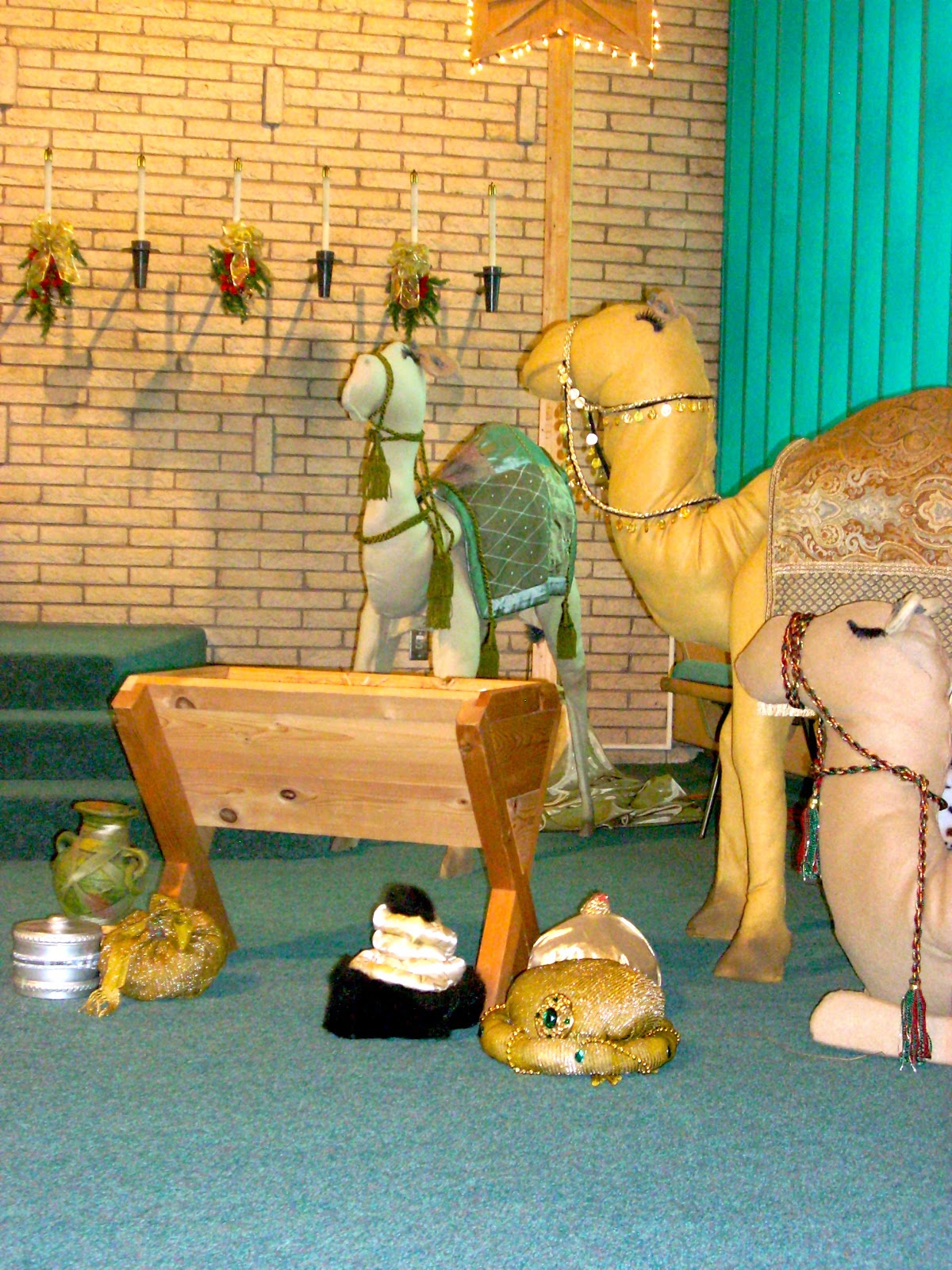
Knowing that we were going to be celebrating Epiphany day and reading about the magi, I had asked if we could please use the camels from the Christmas program. They are the best hand-made camels I have seen and have a great deal of personality. I thought it would be good atmosphere and add some fun and imagination to the celebration. What I didn't count on was the placement of the camels.
I was running a little later than normal so I didn't have time to check the sanctuary before worship and was glad to see the manger and the gifts and those wonderful camels under the star. I didn't think about it until it came time for me to sit in my chair when I realized it was back behind the camels.
During different parts of the service, when it came time for me to sit, I had to look out from behind and around the camels to see the manger and to see the congregation. It was a totally different perspective.
Usually as I preside over worship, I see everyone and everything; but Sunday was different. Unless I moved away from the manger and stood in front, I could only get a partial glimpse of the manger and what was happening in front of me. As I looked, I realized that I have only looked at manger scenes from the front, like watching a performance but Sunday, I saw a view I've never seen before.
I have had that same kind of feeling sometimes when I am studying scripture and I come across a very familiar story that I think I know so well. I think I know the story and the characters and often even the meaning but as I study them, I come across details and ideas that I have not seen before. The story of the Magi is a good example of a story we think we know so well until we really read it. Then we find out that Matthew never tells us how many magi there were or whether or not there were camels. In fact, many of the details we think we know aren't in the Bible!
Both of the experiences are reminders that we need to allow ourselves to be open see and hear the Gospel from a new point of view not only on the page, but also in the people around us. When we think we already know what is coming and what it means, we rob ourselves of new insights, new gifts, and renewed relationships.
In the ninth chapter of John, Jesus heals a man who had been born blind. There are a lot of people that do not understand and question what Jesus has done. At one point, they do not believe that he is the same man until they confront his parents. They are not able to see or believe the truth of Jesus. Finally, they drive out the man whom Jesus healed.
He comes to Jesus and Jesus talks to him and reveals his identity. The man confesses his faith and worships Jesus. He is able to see and believe in Jesus but the Pharisees are not. Jesus warns them (and us) of the peril of refusing to see the truth of Jesus.
Jesus opens our eyes to see with the eyes of faith. Try seeing things in new ways, opening your heart and eyes to the new possibilities of God's love and grace.
"Jesus heard that they had driven him out, and when he had found him, he said, 'Do you believe in the Son of Man?' He answered, 'And who is he, sir? Tell me, so that I may believe in him.' Jesus said to him, 'You have sen him, and the one speaking with you is he.' He said, 'Lord, I believe.' And he worshiped him. Jesus said, I came into this world for judgment so that whose who do not see may see, and those who do see may become blind.'" John 9:35-40
In the ninth chapter of John, Jesus heals a man who had been born blind. There are a lot of people that do not understand and question what Jesus has done. At one point, they do not believe that he is the same man until they confront his parents. They are not able to see or believe the truth of Jesus. Finally, they drive out the man whom Jesus healed.
He comes to Jesus and Jesus talks to him and reveals his identity. The man confesses his faith and worships Jesus. He is able to see and believe in Jesus but the Pharisees are not. Jesus warns them (and us) of the peril of refusing to see the truth of Jesus.
Jesus opens our eyes to see with the eyes of faith. Try seeing things in new ways, opening your heart and eyes to the new possibilities of God's love and grace.
"Jesus heard that they had driven him out, and when he had found him, he said, 'Do you believe in the Son of Man?' He answered, 'And who is he, sir? Tell me, so that I may believe in him.' Jesus said to him, 'You have sen him, and the one speaking with you is he.' He said, 'Lord, I believe.' And he worshiped him. Jesus said, I came into this world for judgment so that whose who do not see may see, and those who do see may become blind.'" John 9:35-40
Friday, January 4, 2013
Freed Love
A sign on a restaurant caught my attention yesterday: "Now hiring Dec. 21 survivors".
We've survived the rollover of the Mayan calendar. Congress finally got us over the "fiscal cliff". And the new year has begun. And soon the twelve days of Christmas will be over.
Many of us will try to start the new year out with resolutions to make a "fresh start" trying to kick old habits, and vowing to live healthier lives. Media has picked up on this and enlarged this very common need to want to make ourselves and our lives better. I notice that more and more, it gets harder to separate the commercials from "media stories" (I don't really want to call it news) about what to buy or use to get thinner, stronger, buffer, more organized, etc... And it's all focused on doing it right now as we begin a new year - as if this is the only or the best time to make changes in our selves and our lives.
Until it's time to get ready for "swimsuit season".
But that is exactly the problem with all of these resolutions. First of all, they assume that it is in our power to change ourselves and that if we don't then it is our fault. And because it is centered around the new year, we have both the excuse and the catch of waiting until next year to try again. Cartoonists are great at skewering us in our foibles. One I saw recently had the character saying that he was just going to use last year's list of resolutions for this year. He didn't need to change it because he still needed to do them all!
Sometimes, we are able to keep new year's resolutions and make some real changes but more often than not, what most people seem get from the experience is a sense of failure. One more time, one more thing not completed or not fixed.
Wouldn't it be nice if there was an alternative?
And there is. It's called grace. God makes things different.
First of all, God's love comes first, just as we are with all our faults, our bad habits, our past, and our inability to fix ourselves.
There is forgiveness. When we fail,fall, or mess up once again, God comes with forgiveness. There is no such thing as only one chance or second chances. Jesus talks about 70 times 70 (or more depending on how you translate the Greek).
Change does not happen on our own. As it says in the Small Catechism, "I believe that by my own understanding or strength..." but it is the Holy Spirit who calls, gathers, enlightens, and makes holy the whole Church. Jesus promises to always be with us.
We get a new chance every day. We do not have to wait for the new year to begin again to have a new chance. Even though you are only baptized once, we are invited to remember that baptism everyday and know that every day even many times in the day, we can come to God and be washed again from our sin, our doubts, our failures, our pain, and whatever we need to bring to God. Day by day or minute by minute, God is with us, giving us new life and freeing us.
We are set free from the measuring rulers and chains of "shoulds" to love others and to love ourselves, which we can only do with God's help and yet are the very things that mark us as people of faith. For just as we cannot come to faith or change without God, the Holy Spirit calls us into community for our survival. It is together that we have new life.
"For you were called to freedom, brothers and sisters, only do not use your freedom as an opportunity for self-indulgence, but through love become slaves to one another. For the whole law is summed up in a single commandment, "You shall love your neighbor as yourself." Galatians 5:13-14
We've survived the rollover of the Mayan calendar. Congress finally got us over the "fiscal cliff". And the new year has begun. And soon the twelve days of Christmas will be over.
Many of us will try to start the new year out with resolutions to make a "fresh start" trying to kick old habits, and vowing to live healthier lives. Media has picked up on this and enlarged this very common need to want to make ourselves and our lives better. I notice that more and more, it gets harder to separate the commercials from "media stories" (I don't really want to call it news) about what to buy or use to get thinner, stronger, buffer, more organized, etc... And it's all focused on doing it right now as we begin a new year - as if this is the only or the best time to make changes in our selves and our lives.
Until it's time to get ready for "swimsuit season".
But that is exactly the problem with all of these resolutions. First of all, they assume that it is in our power to change ourselves and that if we don't then it is our fault. And because it is centered around the new year, we have both the excuse and the catch of waiting until next year to try again. Cartoonists are great at skewering us in our foibles. One I saw recently had the character saying that he was just going to use last year's list of resolutions for this year. He didn't need to change it because he still needed to do them all!
Sometimes, we are able to keep new year's resolutions and make some real changes but more often than not, what most people seem get from the experience is a sense of failure. One more time, one more thing not completed or not fixed.
Wouldn't it be nice if there was an alternative?
And there is. It's called grace. God makes things different.
First of all, God's love comes first, just as we are with all our faults, our bad habits, our past, and our inability to fix ourselves.
There is forgiveness. When we fail,fall, or mess up once again, God comes with forgiveness. There is no such thing as only one chance or second chances. Jesus talks about 70 times 70 (or more depending on how you translate the Greek).
Change does not happen on our own. As it says in the Small Catechism, "I believe that by my own understanding or strength..." but it is the Holy Spirit who calls, gathers, enlightens, and makes holy the whole Church. Jesus promises to always be with us.
We get a new chance every day. We do not have to wait for the new year to begin again to have a new chance. Even though you are only baptized once, we are invited to remember that baptism everyday and know that every day even many times in the day, we can come to God and be washed again from our sin, our doubts, our failures, our pain, and whatever we need to bring to God. Day by day or minute by minute, God is with us, giving us new life and freeing us.
We are set free from the measuring rulers and chains of "shoulds" to love others and to love ourselves, which we can only do with God's help and yet are the very things that mark us as people of faith. For just as we cannot come to faith or change without God, the Holy Spirit calls us into community for our survival. It is together that we have new life.
"For you were called to freedom, brothers and sisters, only do not use your freedom as an opportunity for self-indulgence, but through love become slaves to one another. For the whole law is summed up in a single commandment, "You shall love your neighbor as yourself." Galatians 5:13-14
Tuesday, December 18, 2012
The No-word Prayer
Away in a manger, no crib for his bed,
The little Lord Jesus laid down his sweet head;
The stars in the sky looked down where he lay,
The little Lord Jesus asleep in the hay.
The cattle are lowing; the poor baby wakes,
But little Lord Jesus no crying he makes.
I love you Lord Jesus, look down from the sky
And stay by my cradle till morning is nigh.
In the second verse, as the singers, we ask Jesus to stay with us through the dark and scary night. The carol is not only a song about the nativity, the birth of Jesus in the stable; the carol is also a prayer that Jesus would stay with us, chase fear away and keep us safe.
The third verse is even more of a prayer:
"Be near me, Lord Jesus; I ask you to stay
Close by me forever and love me, I pray.
Bless all the dear children in your tender care
And fit us for heaven to live with you there."
These last days have shattered the bubble of safety we try to keep around children. We wish and pray that our children would never have to know real terror and fear, forgetting that even everyday things and situations can make them afraid from monsters under the bed, having the right answer in school, to facing a bully. Talking to our children about times when we become afraid and giving them tools to use is part of helping them to be resilient.
Prayer is one of the most powerful tools we have against dark and fearful times.
There are many ways and kinds of prayer. Like the carol, we can sing our prayer; many hymns are sung prayers. Written out prayers that we read or memorize are another way to pray. May children learn the bedtime prayer, "Now I lay me down to sleep, I pray the Lord my soul to keep. If I should die before I wake, I pray the Lord my soul to take." It also is a prayer of asking Jesus to stay with us and keep us safe. Sometimes, these kinds of prayers have many words.
We can also just pray by telling God what we are feeling or what we need in whatever words we have at the moment. They can be informal or formal, lots of words or just a few. There are also times when all we have is one word - help. God hears even one-word prayers and is with us.
But sometimes, great fear and/or grief are so overwhelming that we can't find any words to say. The Bible tells us that at those times, perhaps the most powerful, God hears our no-word prayers. Paul writes, "Likewise the Spirit helps us in our weakness... that very Spirit intercedes with sighs too deep for words. " (Romans 8:26) When our hearts are too full or when they feel completely empty, those are the times that God hears us and holds us most deeply; even when all we have are questions or anger.
Since these deepest "no-word" prayers come through the Holy Spirit, like all prayers, they do not depend on our experience of prayer. They can be our first prayer or our last. God hears and holds us in love. And the promise is that there is nothing terrible or strong enough to take us away from that love.
In these last few days before Christmas, it is an even more important time right now to remember that the Jesus we wait for is the light of the world; the light that came into the world and that darkness has not and cannot overcome it. God's love wins.
"For I am convinced that neither death, nor life, nor angels, nor rulers, nor things present, nor things to come, nor powers, nor height, nor depth, nor anything else in all creation, will be able to separate us from the love of God in Christ Jesus our Lord." Romans 8:38-39
(Taken from last Sunday's children's sermon)
Wednesday, December 5, 2012
Who Needs Church?
I had a really interesting conversation in confirmation class this last week. I think it is a set of questions that a lot of people have but most adults don't speak it so clearly. Do we really need to go to church? Isn't it enough to just believe in Jesus on your own?
I began by responding that no, Jesus never told us to go to church. There isn't a law about going to church. The gift of faith isn't invalidated or cancelled if you don't attend.
However, he and his disciples go to the synagogue throughout this ministry and Jesus is pictured more than once as teaching in the temple. From the beginning, following the resurrection, the disciples gathered together for prayer and hear the Word, to share the Meal, and to care for those in need. Following Jesus is not pictured as a solitary activity but instead, Jesus calls and gathers people together. The vision that Paul gives of those who follow Jesus is that together, we are the body of Christ. All of us together make one body.
But my students pushed. 'So I don't HAVE to go to church if I can still believe.'
So I challenged them back. "Right. You may not need to, for yourself. But there are people who need to see you there." Worship is not just about getting but also about giving. One of the major challenges of small town and rural ministry is our shrinking and aging communities. Most of our members are very aware of how things have changed over the last 60 years and how they continue to change. Having our younger members at worship and actively participating and visible in leadership and servant roles is a clear sign of hope and life that the congregation needs. It's not about "passing confirmation" or being good, it is one action that can really make a difference in the lives and outlook of other members.
I'm afraid I got passionate and sermonized a bit. But to get back to the original question, does it really matter?
Yes, it matters. We are created to be in partnership, to be in companionship with one another and with God. The second chapter of Genesis tells of God's search for partnership, for companionship 'because it is not good for one to be alone'. From the resurrection on, God's people have been gathered together around word and sacrament.
Can you pray and hear the word while watching your television or with an on-line community? Sure. But your screen cannot feed you at the Lord's table. We are not just about spirituality and good living, we are the people of God's bread, fed at God's table, and sent to bring that bread out into the world. Real bread. Bread that brings forgiveness but also the bread brought as gifts that goes out to feed the hungry, care for the sick, and gathers in the lost.
Belonging to God is not just an exercise of the inner spirit. Faith is attached to the real physical things of life and death. Both inside and out side of the church, we neglect this truth at our own peril. The Word leads to prayer leads to bringing our gifts leads to thanksgiving leads to the table and back out again into the world to serve and to share. Neither worship nor table nor prayers are an end to themselves but a cycle that strengthens both faith and life.
Can you pray and hear the word while watching your television or with an on-line community? Sure. But your screen cannot feed you at the Lord's table. We are not just about spirituality and good living, we are the people of God's bread, fed at God's table, and sent to bring that bread out into the world. Real bread. Bread that brings forgiveness but also the bread brought as gifts that goes out to feed the hungry, care for the sick, and gathers in the lost.
Belonging to God is not just an exercise of the inner spirit. Faith is attached to the real physical things of life and death. Both inside and out side of the church, we neglect this truth at our own peril. The Word leads to prayer leads to bringing our gifts leads to thanksgiving leads to the table and back out again into the world to serve and to share. Neither worship nor table nor prayers are an end to themselves but a cycle that strengthens both faith and life.
We gather and share ancient words of faith in the creeds. There are times when because of grief or doubt or confusion, I may not understand or be able to claim it as "my" statement of faith, but I can find comfort in the weight of the millennia of saints before, with, and after me that affirm what I cannot firmly hold for myself. It is like a bank that holds the riches in trust for us that we can draw upon when our own pockets of faith feel empty. The words spoken with sureness by all the gathered around us bear witness to God's power and promise even we come before God weak, or empty, and even in anger.
The saints around us are not perfect. They may come grumpy or empty themselves. It is not in the perfection of the assembled people or our worship that matters; we just need to trust in the promise that together Christ is among us and even more than that; together we are the body of Christ given to the world, warts, grumps, hugs, confusion and all.
As you prepare for Christmas, take time to breathe and be gathered together in Christ.
"For where two or three are gathered in my name, I am there among them." (Matthew 18:20)
"But as it is, God arranged the members in the body...If all were a single member, where would the body be? As it is there are many members, yet one body. The eye cannot say to the hand, "I have no need of you," nor again the head to the feet, "I have no need of you." Now you are the body of Christ and individually members of it." (1 Corinthians 12:18-21,27)
The saints around us are not perfect. They may come grumpy or empty themselves. It is not in the perfection of the assembled people or our worship that matters; we just need to trust in the promise that together Christ is among us and even more than that; together we are the body of Christ given to the world, warts, grumps, hugs, confusion and all.
As you prepare for Christmas, take time to breathe and be gathered together in Christ.
"For where two or three are gathered in my name, I am there among them." (Matthew 18:20)
"But as it is, God arranged the members in the body...If all were a single member, where would the body be? As it is there are many members, yet one body. The eye cannot say to the hand, "I have no need of you," nor again the head to the feet, "I have no need of you." Now you are the body of Christ and individually members of it." (1 Corinthians 12:18-21,27)
Thursday, November 8, 2012
Dancing Down the Aisle!
It was probably a bit different than many weddings you go to. For one thing, there were a lot of pastor-types around. Not only are my husband and I both pastors, but Ben is a pastor, his wife Mara is finishing her studies at Seminary this year, and they involved many of their friends in the service. I lost count at 9 (I think) and that was just at the rehearsal!
You might think that with all those clergy around, it was a somber, serious affair with a large dose of "you have to do it this way". Granted, there was a bit of discussion about where people were going to stand, sit, and process but it was more about how to make things work well rather than laying down any sort of liturgical order. It was one of the most relaxed and joyful weddings I've experienced. You could tell that people felt at home in the church, even though many of us were there for the first time.
Some of the differences from TV/movie weddings:
Perhaps the most central difference was that Ben and Mara put the focus of the service on God and living in faith. For them, this was most definitely a worship service of Word and Sacrament and they came for God's blessing. All of the other choices followed from this truth.
* The entire wedding party entered the church in procession while the congregation sang "Christ Has Arisen, Alleluia" (a Tanzanian Easter hymn) and we fairly danced out to "Let Us Talents and Tongues Employ". We sang "Where Charity and Love Prevail" as hymn of the day. This is something my husband and I did at our wedding. I wish I could say I was smart enough that we knew it when we did it, but doing that has been a great blessing. Unlike wedding songs that are soon forgotten or become embarrassing later on, our hymns have followed us throughout our lives, continuing to connect our marriage to faith in God.
* We celebrated Holy Communion and along with that (as was true from the beginning in the early church), an offering was taken going to a more local charity and the ELCA Malaria Campaign.
* Along with the Flower Girl, they had a Bible-bearer. Instead of a ring bearer with little pillow, Ben's Godson carried a Bible to the front which then was read and preached from during the service and is now Ben & Mara's family Bible.
* The preacher was carefully chosen and lifted up the Good News for all of us. We were both challenged and filled.
When the service was done, my younger sister remarked, "Why can't church on Sunday be this much fun?"
The reality is that it can be. This service was carefully and thoughtfully planned with a lot of effort and focus. The presiding pastor did not carry that burden alone. There were a lot of people that came prepared to worship with holy glee and celebrate faithfully. I'm afraid that all too often, pastors (myself included) come to worship bearing the burden of the service alone or nearly alone, and doing what has been done because they are too busy, tired, rushed, crammed, or depressed to do anything else.
What if a group came to church earlier in the week to plan and rehearse for worship? What if many of the people came to worship ready to give to those in need, to come hungry to the table, to pray, and to celebrate the gift of Christ? What if we allowed ourselves to come to worship expecting to have fun?
Worship can be fun when we come faithful, when we come prepared, and when there is participation by many in the preparation, and no one person is counted on to do everything. No one has shoulders big enough to carry that for very long. Liturgy really is the work of the people and the more of us that come ready to participate and give of ourselves faithfully, the fuller our experience will be. The more we give, even sitting in the pew, the fuller our hearts will be. Worship is not about what we get but what we give. Read: Acts 2:46-47.
Wednesday, November 7, 2012
Wednesday, October 3, 2012
Faith and a Haircut
I went to get my hair cut several days ago. It's a treat I try to get done on my day off. I have to admit that I love the luxury of settling down and having someone else wash my hair, especially since they usually take their time and give me a scalp massage at the same time. As I sat there, I told the beautician that if she kept it up, I would probably start purring!
Then we moved back to the cutting and styling area and conversation began. She began by asking what I wanted her to do with my hair and moved on to asking about me. She's a stylist I haven't seen before so she asked what I do. I wondered what her reaction would be as I told her that I am a Lutheran pastor.
I felt her somewhat wary response. She wanted to know more about what church I served and what kind of Lutheran I am. She kept hesitating and finally asked if I was one of "those" Christians or if I was - and at this point she kind of lost words. So I finished the sentence for her, "I'm an ELCA pastor, we are the welcoming Lutherans."
By this time, I had kind of an idea of where she was going. It's a question a lot of younger adults ask with their tattoos and varied lives, they are searching to find out if it is safe to be themselves in front of me. Will I accept or will I judge.
She sighed and visibly relaxed. Then she began to talk about herself and her struggles to find a place accepting not of just her, but also family and friends that are gay or different in one way or another. We talked about how it can be so agonizing to tell our family about very deep and important things about us. She had a relative who recently told the family that he was quitting his career and going to seminary. He was convinced everyone would be shocked and aghast. Their actual response? 'Duh! What took you so long!'
We moved from that to people we knew who have come out of the closet and admitted openly to themselves and others that they are gay. And sometimes the response is the same, a sort of 'I could have told you that years ago'. But it remains an agonizing experience and the person is not always welcomed anymore, even by their family.
She asked how I held this together with my faith. (By now, this haircut was becoming serious conversation.) I told her that first I looked to Jesus, what he did and what he says and when I do that, I see a life spent in welcoming the least of these my brothers and sisters. He was always getting into trouble with those in power because of the outcasts, sinners, and disreputable people that he ate with and forgave. Over and over, Jesus says we will be known by our love, that this is the sign of discipleship.
By now my hair was cut and dried and our conversation done. She gave me a radiant smile and thanked me as I thanked her for the great cut. As I waited for my husband, I thought about our conversation. What had started out as chat between strangers had become holy dialogue about welcome versus judgment. Would I accept her and the people she loved?
Isn't this the question we all have of God? Does God really love us, accept us as we are, or is there some sort of sword of doom hanging over our heads?
I am so grateful that I was listening carefully enough to hear the question she didn't know how to ask at first and that I didn't turn the conversation into a lecture or sermon. For that I have to thank a friend of mine who left his church because he said he was tired of being tolerated when he needed to be accepted and loved.
Opportunities for these conversations happen all around us if we open our minds and ears to hear not only what is being said but to also hear what the heart is saying under the words. If we let ourselves get distracted by arguing about the way things have always been or how they should be, we may miss the opportunity to share the "old, old story" of Jesus and his love. Once we meet and get to know one another and meet in Christ's love, then we can go on from there to talk more, but first, we need to meet in a safe and welcome place. Christ's love is a good place to begin. Read John 13:34-35 and Mark 9:42
Then we moved back to the cutting and styling area and conversation began. She began by asking what I wanted her to do with my hair and moved on to asking about me. She's a stylist I haven't seen before so she asked what I do. I wondered what her reaction would be as I told her that I am a Lutheran pastor.
I felt her somewhat wary response. She wanted to know more about what church I served and what kind of Lutheran I am. She kept hesitating and finally asked if I was one of "those" Christians or if I was - and at this point she kind of lost words. So I finished the sentence for her, "I'm an ELCA pastor, we are the welcoming Lutherans."
By this time, I had kind of an idea of where she was going. It's a question a lot of younger adults ask with their tattoos and varied lives, they are searching to find out if it is safe to be themselves in front of me. Will I accept or will I judge.
She sighed and visibly relaxed. Then she began to talk about herself and her struggles to find a place accepting not of just her, but also family and friends that are gay or different in one way or another. We talked about how it can be so agonizing to tell our family about very deep and important things about us. She had a relative who recently told the family that he was quitting his career and going to seminary. He was convinced everyone would be shocked and aghast. Their actual response? 'Duh! What took you so long!'
We moved from that to people we knew who have come out of the closet and admitted openly to themselves and others that they are gay. And sometimes the response is the same, a sort of 'I could have told you that years ago'. But it remains an agonizing experience and the person is not always welcomed anymore, even by their family.
She asked how I held this together with my faith. (By now, this haircut was becoming serious conversation.) I told her that first I looked to Jesus, what he did and what he says and when I do that, I see a life spent in welcoming the least of these my brothers and sisters. He was always getting into trouble with those in power because of the outcasts, sinners, and disreputable people that he ate with and forgave. Over and over, Jesus says we will be known by our love, that this is the sign of discipleship.
By now my hair was cut and dried and our conversation done. She gave me a radiant smile and thanked me as I thanked her for the great cut. As I waited for my husband, I thought about our conversation. What had started out as chat between strangers had become holy dialogue about welcome versus judgment. Would I accept her and the people she loved?
Isn't this the question we all have of God? Does God really love us, accept us as we are, or is there some sort of sword of doom hanging over our heads?
I am so grateful that I was listening carefully enough to hear the question she didn't know how to ask at first and that I didn't turn the conversation into a lecture or sermon. For that I have to thank a friend of mine who left his church because he said he was tired of being tolerated when he needed to be accepted and loved.
Opportunities for these conversations happen all around us if we open our minds and ears to hear not only what is being said but to also hear what the heart is saying under the words. If we let ourselves get distracted by arguing about the way things have always been or how they should be, we may miss the opportunity to share the "old, old story" of Jesus and his love. Once we meet and get to know one another and meet in Christ's love, then we can go on from there to talk more, but first, we need to meet in a safe and welcome place. Christ's love is a good place to begin. Read John 13:34-35 and Mark 9:42
Saturday, September 15, 2012
Tongues on Fire
Last night found me sitting in the stands at the football game. As the game went on, I found myself reflecting on the cheering I'd been hearing and had been part of at those games. There was a lot of cheering for our side, encouraging individuals, recognizing good efforts, and groaning when things didn't go our way. But for the most part, there wasn't any booing or negative cheers against the opposing teams.
Now granted, this is probably a more gentle form of football than can be found at larger venues, or college or pro ball. (You know you are at a small town, small school game when the national anthem is sung by a second grader and one of the officials is introduced as John Smith, nephew of Joe.) This is not to say that there wasn't competition or that the teams weren't trying their hardest - they do their best. But there was mingling around the concession stand, talking amongst people, and most people were just enjoying the evenings.
What got me in this mood was thinking about the events of this week. There seems to be a strong cultural shift to polarizing people into sides separated by differing thoughts and/or beliefs. And disagreeing isn't enough; the separation gets cemented by disrespect, disdain, and outright hateful acts and speech. In this kind of divided thinking, we aren't just different, we (whoever we are) are right and they (whoever they are) are wrong. This attitude shows itself everywhere from politics and international relations to church and family relations.
It feels like we have forgotten to be nice and to remember that we need each other and have to live with each other.
And into this mix, there was thrown the Molotov cocktail of the movie defaming the prophet Mohamed and the Islamic faith. Violent protests have spread in several nations taking the lives of Ambassador Stevens and three of his staff and causing other injuries and destruction of property. And all of this, on both sides, has been done (once again) in the name of God.
The second reading for Sunday comes from the letter of James. In it, James writes about the dangerous power of the tongue and how much damage words can cause when they are either careless or abusive. The burnt out U.S. Embassy in Libya is a graphic depiction of the destructive power of words.
More invisible but also painful are the divisions and injury caused by words in our own communities, families and churches. Sometimes our words are literally thoughtless, spoken unguardedly without thinking through the consequences. But there are other times when we plan our words, thinking that we can strike out at someone else without wounding ourselves.
The words of James remind us that as we are loved by God, we need to live that love in all our relationships. As he says, we are to live so that our actions "are done with gentleness born of wisdom". In a world where speech has become a bloodsport, with God's help, even our words should witness to God's love. Read James 3:1-13
Tuesday, August 28, 2012
Holy Karaoke!
I had the most fun the other night. I laughed until the tears ran down my cheeks and my abs (such as they are) got a real workout. I went to a concert; well it was really a sing-a-long. We sang songs from old movies and musicals. I suppose you could compare it to live-action Karaoke as there was a group of singers and players leading us in the songs and the audience was definitely encouraged to sing along.
I came in late and so I ended up sitting in front and found myself sitting next to someone who was having just as much fun as I was singing along to the songs and hamming it up a bit. We surprised ourselves by remembering so many words.
I was reminded of my mother and one of the things she used to do that embarrassed me so much as a teenager. I mentioned to my seatmate that my mom always seemed to have a song for everything; give her a phrase or a situation or name something and Mom could have a song that fit. She said her mom was similar, and now look at us, instead of being embarrassed, we are being just like our mothers and enjoying it. (It happens more often than we like to admit!)
It's fun to sing together - even if you can't carry a tune. While at seminary, we belonged to a local mission congregation whose pastor loved to sing hymns, and he sang with lots of energy and volume even though the tune might be totally unrecognizable. And yet, his joy and enthusiasm also came through loud and clear and the congregation also sang with passion.
Singing is fun and a lot of people enjoy singing together even if we don't get many chances to do it. But put singing together and church in the same subject line, and controversy seems sure to follow. Much of the cussin' and discussion about worship and liturgy ends up being about what music to sing and how to sing it.
Not only do most people seem to have an opinion about what they like and think is appropriate, but our song has become loaded down with lots of extra baggage. Do we sing "old favorites" or contemporary? On which generation do we focus our attention? At the base of these kinds of questions may be the real issue, which is bringing more people to worship.
Now scads and scads of stuff has been written on the subject but I'm not going to get into that. As I sang my heart out the other night, what I experienced is something else.
When people get together and are led with joy and passion, people like singing together. It's not the style of the music or the ability of each person singing. Certainly the other night there were those who just sat and enjoyed listening to the whole experience. Some people knew more words than others. But there is something about being in a group and singing together that is uplifting and energizing. Look at flash mob choirs, karaoke bars, and the popularity of shows like Glee; a lot of people like to sing.
The point isn't which songs we sing, or the style of the music, or how new or old it is. The point is singing together; the joy and passion are catching. I have a strong feeling that the secret to making our music attractive to others is not necessarily which music we pick but whether or not we love and enjoy that music and want to share it. The key is doing this in community as a community.
Our communal song will be shaped by who we are, our shared experiences, and our individual lives and gifts as well. If we are not good at singing together, we may need to learn more music and spend time learning how to sing together. Sometimes, our singing together may sound like a choir with balanced tones and harmonies and other times we may just make some joyful noise together. The point isn't which song we sing or how well we sing, it is that we come together in faith and lift each other up by joining in song. Certainly there is power in music, and the music of faith is the most powerful of all. Read Ephesians 5:15-20.
I came in late and so I ended up sitting in front and found myself sitting next to someone who was having just as much fun as I was singing along to the songs and hamming it up a bit. We surprised ourselves by remembering so many words.
I was reminded of my mother and one of the things she used to do that embarrassed me so much as a teenager. I mentioned to my seatmate that my mom always seemed to have a song for everything; give her a phrase or a situation or name something and Mom could have a song that fit. She said her mom was similar, and now look at us, instead of being embarrassed, we are being just like our mothers and enjoying it. (It happens more often than we like to admit!)
It's fun to sing together - even if you can't carry a tune. While at seminary, we belonged to a local mission congregation whose pastor loved to sing hymns, and he sang with lots of energy and volume even though the tune might be totally unrecognizable. And yet, his joy and enthusiasm also came through loud and clear and the congregation also sang with passion.
Singing is fun and a lot of people enjoy singing together even if we don't get many chances to do it. But put singing together and church in the same subject line, and controversy seems sure to follow. Much of the cussin' and discussion about worship and liturgy ends up being about what music to sing and how to sing it.
Not only do most people seem to have an opinion about what they like and think is appropriate, but our song has become loaded down with lots of extra baggage. Do we sing "old favorites" or contemporary? On which generation do we focus our attention? At the base of these kinds of questions may be the real issue, which is bringing more people to worship.
Now scads and scads of stuff has been written on the subject but I'm not going to get into that. As I sang my heart out the other night, what I experienced is something else.
When people get together and are led with joy and passion, people like singing together. It's not the style of the music or the ability of each person singing. Certainly the other night there were those who just sat and enjoyed listening to the whole experience. Some people knew more words than others. But there is something about being in a group and singing together that is uplifting and energizing. Look at flash mob choirs, karaoke bars, and the popularity of shows like Glee; a lot of people like to sing.
The point isn't which songs we sing, or the style of the music, or how new or old it is. The point is singing together; the joy and passion are catching. I have a strong feeling that the secret to making our music attractive to others is not necessarily which music we pick but whether or not we love and enjoy that music and want to share it. The key is doing this in community as a community.
Our communal song will be shaped by who we are, our shared experiences, and our individual lives and gifts as well. If we are not good at singing together, we may need to learn more music and spend time learning how to sing together. Sometimes, our singing together may sound like a choir with balanced tones and harmonies and other times we may just make some joyful noise together. The point isn't which song we sing or how well we sing, it is that we come together in faith and lift each other up by joining in song. Certainly there is power in music, and the music of faith is the most powerful of all. Read Ephesians 5:15-20.
Wednesday, August 1, 2012
Jesus Wins Wood
The city sign at the intersection of both highways reads, "It could be worse. It could be winter."
It was 92 yesterday according to the bank sign, it could be near 100 today, and we are still very dry although we did get a spit of rain Sunday evening. Up here the winters can also be severe with 20 to 30 below zero temperatures fairly normal. In this context, the sign makes sense. It could be worse (until you look at the fields).
The sign reflects a very human tendency to evaluate things by how they are in relation to other things. This can be uplifting when you see someone else's circumstance and realize things aren't as bad as you thought. But it can also be very negative when we look at what we have and find it lacking simply because we see someone else as having better or more. At that point, it can bring out the worst in egotism, envy, and selfishness.
I've been watching the Olympics when I can and this attitude has been very obvious in the reporting when a favored American athlete only gets a silver or a bronze instead of the gold medal. They didn't win. They didn't get first. It's a tragedy. They are only second or third or fourth out of all the athletes in the world that competed to be there at that event.
And yet this is set within the Olympics with a history and philosophy where it is an honor just to compete for your country and where the Olympic spirit is defined by someone who pushed through just to complete the event. I was reminded of this yesterday when I caught some of the solo sculling (rowing) competition.
They were showing a race heat where an African athlete had taken up the sport just three months ago in order to compete for his country. Even though he was a full minute behind the other slowest competitor in the heat and all the rest of the contestants were off the course, he was still pulling as hard as he could to finish the race as best he could. And in true Olympic spirit, the same crowd that had been fiercely urging on the winners was cheering and screaming in support for him to finish the race.
Every Olympics, there are the stories of athletes who are "terrible" at their sport - in no way able to compete for world-class times and scores and yet they come, proudly marching in to represent their country. I remember the runner who fell near the end, and in spite of being injured, struggled to limp across the line and finish the race. And of course there was the Jamaican bobsled team whose story was told in the movie "Cool Runnings".
Does it really matter if someone has it better or worse than we do? Is that the scale we are to use or does faith change things?
When I was a teenager, I remember a televised minute devotion that would come on everyday. My mom liked it and so she tried to watch it all the time. Each time, he ended the thought for the day, "This is the day that the Lord has made; let us rejoice and be glad in it." (Psalm 118:24) I was totally into the trauma-drama of being a teenager and how awful my life was and what I couldn't do and couldn't have. I could not understand how and why I was supposed to rejoice when things could be "so bad".
I have to admit, there have been many times when things really have been bad and I had neither the heart nor the strength to rejoice. So how do we grapple with the intent of this verse during those hard times? Does God really expect us to be thankful in the middle of pain or illness or grief?
The key to living with this verse is in its' context. Verse 22 talks of the "stone that the builders rejected" which Christians take to speak of Jesus. The last verse of the psalm confesses faith, giving thanks to God whose love endures forever.
If we look at life from the context of whether we win the gold, these verses don't make sense. But instead, we are invited to life and love through Jesus who not only didn't get the gold, he took the cross for our sake. We rejoice not because we have it so good right now or in comparison to the person next to us but we rejoice because God's love for us endures through it all. We will falter, we will fall, but God's love is steadfast. Just to be here, to be able to stand in God's love and be able to share that love with others is everything. Read Psalm 118:21-29.
It was 92 yesterday according to the bank sign, it could be near 100 today, and we are still very dry although we did get a spit of rain Sunday evening. Up here the winters can also be severe with 20 to 30 below zero temperatures fairly normal. In this context, the sign makes sense. It could be worse (until you look at the fields).
The sign reflects a very human tendency to evaluate things by how they are in relation to other things. This can be uplifting when you see someone else's circumstance and realize things aren't as bad as you thought. But it can also be very negative when we look at what we have and find it lacking simply because we see someone else as having better or more. At that point, it can bring out the worst in egotism, envy, and selfishness.
I've been watching the Olympics when I can and this attitude has been very obvious in the reporting when a favored American athlete only gets a silver or a bronze instead of the gold medal. They didn't win. They didn't get first. It's a tragedy. They are only second or third or fourth out of all the athletes in the world that competed to be there at that event.
And yet this is set within the Olympics with a history and philosophy where it is an honor just to compete for your country and where the Olympic spirit is defined by someone who pushed through just to complete the event. I was reminded of this yesterday when I caught some of the solo sculling (rowing) competition.
They were showing a race heat where an African athlete had taken up the sport just three months ago in order to compete for his country. Even though he was a full minute behind the other slowest competitor in the heat and all the rest of the contestants were off the course, he was still pulling as hard as he could to finish the race as best he could. And in true Olympic spirit, the same crowd that had been fiercely urging on the winners was cheering and screaming in support for him to finish the race.
Every Olympics, there are the stories of athletes who are "terrible" at their sport - in no way able to compete for world-class times and scores and yet they come, proudly marching in to represent their country. I remember the runner who fell near the end, and in spite of being injured, struggled to limp across the line and finish the race. And of course there was the Jamaican bobsled team whose story was told in the movie "Cool Runnings".
Does it really matter if someone has it better or worse than we do? Is that the scale we are to use or does faith change things?
When I was a teenager, I remember a televised minute devotion that would come on everyday. My mom liked it and so she tried to watch it all the time. Each time, he ended the thought for the day, "This is the day that the Lord has made; let us rejoice and be glad in it." (Psalm 118:24) I was totally into the trauma-drama of being a teenager and how awful my life was and what I couldn't do and couldn't have. I could not understand how and why I was supposed to rejoice when things could be "so bad".
I have to admit, there have been many times when things really have been bad and I had neither the heart nor the strength to rejoice. So how do we grapple with the intent of this verse during those hard times? Does God really expect us to be thankful in the middle of pain or illness or grief?
The key to living with this verse is in its' context. Verse 22 talks of the "stone that the builders rejected" which Christians take to speak of Jesus. The last verse of the psalm confesses faith, giving thanks to God whose love endures forever.
If we look at life from the context of whether we win the gold, these verses don't make sense. But instead, we are invited to life and love through Jesus who not only didn't get the gold, he took the cross for our sake. We rejoice not because we have it so good right now or in comparison to the person next to us but we rejoice because God's love for us endures through it all. We will falter, we will fall, but God's love is steadfast. Just to be here, to be able to stand in God's love and be able to share that love with others is everything. Read Psalm 118:21-29.
Tuesday, July 24, 2012
After Aurora
(From my sermon Sunday)
There are times when the
events that happen outside of our community have the ability to affect us
deeply, especially when they are as tragic as the shooting early Friday morning
in Aurora, Colorado. The violence and evil shock us and we are left to
try and make sense of the chaos. We are left with questions.
For some
of those questions, there are armies of people already working to find the
answers. This kind of disaster is also a crime scene and there are many
kinds of law enforcement people doing their tasks to investigate, search out
and catalogue all the bits and pieces that are the evidence.
The media
is also searching for answers but in today’s world, that search is more like an
unorganized competition where getting an answer first sometimes seems more
important than getting it validated. They cluster around the scene trying
to get as close as they can to victims and their families and friends as well
as hounding anyone who knows or has had contact with the one did it.
With all
these people working, we soon know what happened, where and when, and then we
start knowing whom. The investigators are piecing together the answers to
how it happened. But there is one question left, the big one.
Why?
It’s a
huge question because it encompasses so much.
Why did the shooter do it? Why
this theater, this movie? Victims and families ask, why did this person
live and this person die?
We confront God with the biggest question: Why, God? Why do
you allow this happen?
Soon,
someone somewhere will say that this is all God’s punishment for our
godlessness or whatever sin is their pet peeve. It happened after
Oklahoma City, it happened after 9/11, and after hurricane Katrina. It’s not the
Gospel that Jesus teaches, but some people seem to find pleasure in using
tragedy to judge others.
Such
messages can be attractive because they seem to give an answer to that biggest
question. There is a reason that this happened and we are reassured that
God is in control. It is the same kind of comfort that people try to give
when someone we love has died. There is a reason. God is in
control.
If we can
blame someone or something, even God, then we are closer to making sure it
doesn’t happen to us. We like things to have a reason. It lessens
the chaos and confusion in our lives.
In Mark
6: 30-34, Jesus tries to take the disciples and himself away for rest from
their work, but the people see where they are going and by the time the boat
gets to the deserted place, a great crowd of people are already there, waiting
for Jesus.
They are
overwhelmed by the chaos in their lives, things they have no answers for and no
control over. They need help, they need answers, and they need love.
And Jesus has compassion for them. He sees they are like sheep
without a shepherd – meaning they have no one looking out for them, caring for
them, keeping them safe. So Jesus begins to teach and heal them.
Jesus
sees all these people who have followed them with all their needs and
questions, and reaches out. He looks on them with love and becomes their
shepherd.
They have
followed him out into the wilderness probably without a lot of preparation or
thought to simple things like where and how will they eat or find water. In fact, in
the verses following these, Jesus feeds them all, more than 5,000, with a small
boy's lunch. They have come with needs and Jesus cares for them.
If only
Jesus were here today, right? Wouldn’t that make things easier?
Doesn’t this last week just make you wish you could be in that crowd with
Jesus? We need Jesus too!
And Jesus
is here, right here, with us today, right now, in this place, with us and in
us. We are not alone. And he is here, teaching us too, giving us
his answers, and giving us hope.
Jesus
looks at us, with all our questions and doubts, with all our faults and
failings, our shortcomings, and our stubbornness, and holds us in love.
It is here. For you! Right now. And that is as true and
real as it gets. Jesus is here in love – for you.
But even when we don't have answers, we do have hope. For no matter what is happening around us,
we have the promise and hope that we are held in God’s love. And there is
nothing strong enough, or evil enough, or big enough, or bad enough to separate
us from that love. Nothing. Not lone gunmen, or terrorists, or evil
plots, or wars, or diseases, or the chaos of our lives.
God is
here. God is with you and stays with you. God goes with you in
love, whereever you go. And God loves you, forgives you, and gives you
peace, even when we can’t know or understand the whys of what happens
around us. God's love outlasts and outbests everything. Read Romans
8: 35-39.
Subscribe to:
Posts (Atom)